Japanese Beetle Biocontrol
What are Japanese Beetle?
Japanese beetle (Popilliae japonica) are an invasive coleopteran pest originating from Japan. They were introduced to the United States in New Jersey in 1916. Since then, they have spread throughout the northeast, midwest, and southeast United States. USDA APHIS currently maintains a quarantine to prevent their spread to westward.
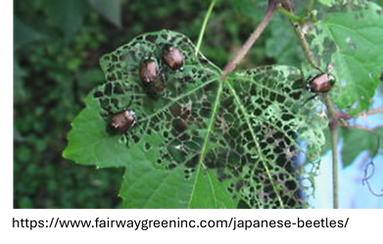
Japanese beetle larvae primarily feed on grass roots and are especially destructive for turfgrass systems. Adult beetles are highly polyphagous, feeding on over 350 plant hosts that includes ornamental species, such as rose and linden trees, and specialty crops, such as grapes, raspberry, and apples. Because of this, Japanese beetle are considered significant agricultural and urban pests.

What is Ovavesicula popilliae?
Ovavesicula popilliae (OP) is an obligate microsporidian pathogen that infects the Malpighian tubules of Japanese beetle grubs. It was first discovered in Connecticut in 1985, and has since been documented in several other parts of the U.S. (Hulbert et al., 2020).
OP spores exist in the soil and grubs become infected by consuming spores while feeding on grass roots. The pathogen colonizes the hindgut (Malpighian tubules) and replicates causing dysfunction. Infection only occurs in the grub life stage and can cause 50% overwintering mortality. Additionally, the reproductive output of surviving grubs is also reduced by 50% (Smitley et al., 2011). At established sites, OP can be reduced Japanese beetle population by 30% in the first six years and up to 75% after 18 years (Smitley et al., 2022), making OP a safe, sustainable biocontrol agent for long-term pest management.
Although OP has been identified at sites in Tennessee, data is lacking for Alabama. The Dr. Deans' Lab at the University of Alabama Huntsville is working on USDA-funded grant to survey for Ovavesicula popilliae throughout the state.


Although OP has been identified at sites in Tennessee, data is lacking for Alabama. The Deans' Lab at the University of Alabama Huntsville is working on USDA-funded grant to survey for OP throughout the state. We all always looking for new places to survey. If you have issues with Japanese beetle and want to be a collaborator, please contact us!
Dr. Carrie Deans
University of Alabama Huntsville
Biological Sciences
256-824-2136
cad0744@uah.edu